Passer au contenu principal
OCW IHE DELFT
  • Accueil
  • Calendrier
  • Plus
Français ‎(fr)‎
English ‎(en)‎ Español - Internacional ‎(es)‎ Français ‎(fr)‎ العربية ‎(ar)‎
Vous êtes connecté anonymement
Connexion
OCW IHE DELFT
Accueil Calendrier
Tout déplier Tout replier

Sustainable development of groundwater from nature based storage (NBS) for rural multi-purpose water supply

Résumé de section

  • Welcome to the online short course "Sustainable development of groundwater from nature based storage (NBS) for rural multi-purpose water supply", built with the support of NUFFIC. In this course we introduce the theory through recorded lectures and add quizzes and small exercises for personal assessment of progress and understanding. This serves as a basis for more practical field training that is essential to become a specialist in the field!
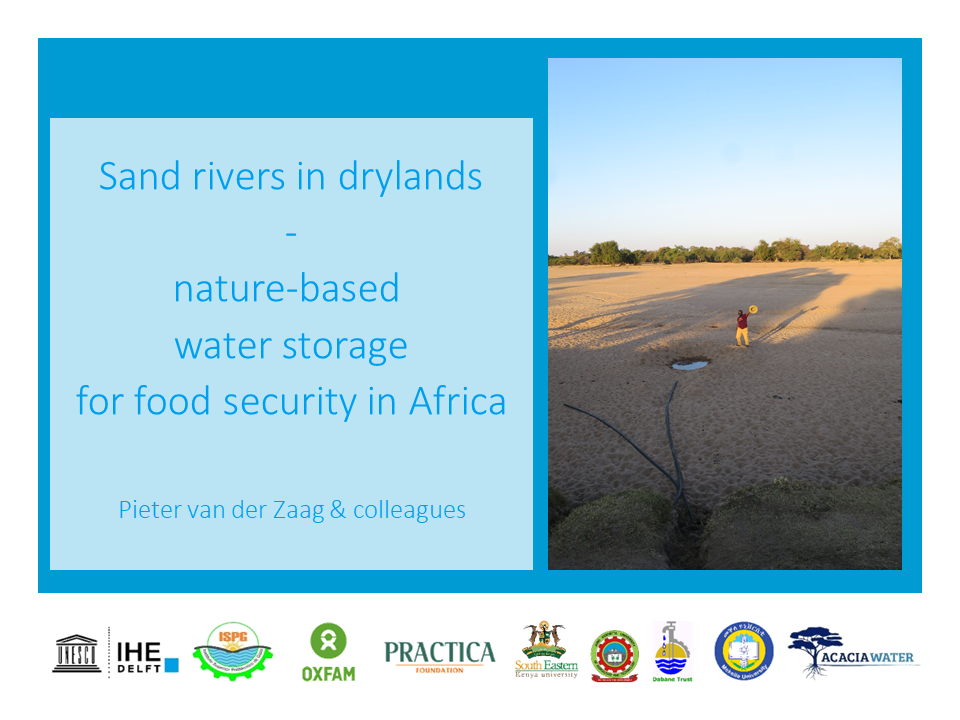


    Sand_River_Intro_Title_Slide          

    https://ocw.un-ihe.org/pluginfile.php/140503/course/section/4067/Fly_Over_Limpopo.mp4?time=1637318673560


    • Announcements Forum
  • ToT1. Groundwater resources assessment, exploration and monitoring in nature based storage (NBS)
  • ToT2. Water supply and treatment from NBS for domestic supply to rural households
  • ToT3. Water supply and treatment from NBS for irrigation and cropping
  • ToT4. Multiple-Use Services: combining domestic water supply and irrigation systems smartly
    • Course guide Fichier
      Les étudiants doivent
      Marquer comme terminé
    • Topic 4.1.1: Water and livelihoods Fichier
      Les étudiants doivent
      Marquer comme terminé

      This topic (recording here) defines what (rural) livelihoods are and how water plays a role in these. Specific topics to be addressed include:

      ·         Livelihoods: basic concepts and types and characteristics of livelihoods in the rural areas

      ·         Role of water use in livelihoods, differentiating between large-scale, smallholder and homestead-based livelihoods, and rural dwellers


    • Topic 4.1.2: Demand for, access to and use of water Fichier
      Les étudiants doivent
      Marquer comme terminé

      This topic (recording here) looks into the differences between demand, access and use of water. It starts by looking into typical water demands that derive from people’s livelihoods. It then looks into the definition of access. Then, different degrees in access and ways of quantifying that are presented, using the service levels. Thirdly it looks into actual use. In this, a differentiation will also be made in access to water resources and to water services. Finally, participants learn to analyse those factors that may lead to a difference between what people demand and what access they have. Specific issues that are looked into are:

      ·        Difference in access to water resources and water services

      ·        Gender and equity in access

      ·        Design norms vs user needs


    • Topic 4.1.3: Participatory assessment tools Fichier
      Les étudiants doivent
      Marquer comme terminé
    • Topic 4.1.3: Participatory assessment tools - exercise sheet Fichier
      Les étudiants doivent
      Marquer comme terminé
    • Topic 4.2.1: MUS as a concept Fichier
      Les étudiants doivent
      Marquer comme terminé
    • Topic 4.2.2: MUS as an approach Fichier
      Les étudiants doivent
      Marquer comme terminé
    • Topic 4.2.2: guideline for planning and providing multiple-use services Fichier
      Les étudiants doivent
      Marquer comme terminé
    • Topic 4.2.3: field assignment planning for MUS Fichier
      Les étudiants doivent
      Marquer comme terminé
    • Topic 4.3.1: Service delivery models for multiple-use services Fichier
      Les étudiants doivent
      Marquer comme terminé
    • Topic 4.3.2: Assignment: assessing opportunities of service delivery models around sand rivers for providing multiple-use services Fichier
      Les étudiants doivent
      Marquer comme terminé
Vous êtes connecté anonymement (Connexion)
Résumé de conservation de données
Obtenir l’app mobile
Fourni par Moodle